
Sermons
Subscribe on Your Favorite Platform:
The Hope at the Center (12.14.25)
A sermon on Lamentations 3.
So, we are in the midpoint of the book of Lamentations. Lamentations (if you haven’t been here for the last few weeks) is a short little book, right in the middle of the Bible. It’s a collection of five poems that deal with sadness, heartache, and grif. And we’re reading it during Advent!
Because it’s not Christmas yet, amen? Our society likes to start Christmas a little early—with sales starting in mid-October. But this isn’t Christmas—we are in the season of Advent. And Advent is a season of hope. It’s a season of waiting. A season of darkness, when we yearn for the Light. But that Light hasn’t come yet.
This time of year can be particularly hard for folks who are enduring loss or hardship. It’s difficult to be surrounded with all the lights and excitement of Christmas, when you yourself are hurting. So, we’re spending Advent in Lamentations.
Another aspect of this study that I’m really excited about is our Call for Laments. You might have noticed as you passed through the Narthex today that we have a lament board—right outside the sanctuary.
For the last couple Sundays, we’ve had this call for submissions in the bulletin. We are inviting you to make a lament—to take whatever sadness, whatever grief or heartache you happen to be carrying and express it through lament.
This could take the form of a poem you write, or a prayer. Maybe you want to create a piece of visual art or take a photo. There’s no wrong way to do this!
We’ve already gotten a few submissions. There’s a couple of poems out there and a prayer. Cheyenne Miller created a beautiful painting. Someone sent in a poem about suffering with plantar fasciitis! I read it and I have never felt more seen!
But please, before you leave today, take a look at the lament board. Read the bulletin insert. And if you’d like to make a lament, bring it to church by the end of the month and we’ll add it to the display.
This sermon is called: “The Hope at the Center.” We’re looking at the third poem in Lamentations. And similar to previous weeks, I wanna start by looking at what the poet is doing—the structure and the artistry of the poem. Then, once we’ve had that little peek behind the curtain, we’ll dig into some of the specifics.
Way back in week one of this series, I mentioned that the five poems of Lamentations are acrostics. Do you guys remember this? An acrostic is a poem that follows the alphabet. The first line starts with the letter A. Line two starts with the letter B. Then C and D—all the way down to Z.
The poems of Lamentations are based on the Hebrew alphabet, which has 22 letters. Here they are in all their glory…

A few of you mentioned last week that the poems of Lamentations don’t look like acrostics in English. That’s because it’s almost impossible to translate an acrostic (and keep that letter-by-letter format) when you’re translating between two languages with totally different letters.
Like, you could do it. The translators could try to make the first line start with A, instead of that squiggly nonsense on there. But you wouldn’t make it all the way to Z because they only have 22 letters!
The first poem in Lamentations (Lamentations 1) has 22 verses—one verse for each letter. Lamentations 2 also has 22 verses—and it’s the same for chapters 4 and 5. But Lamentations 3 is different!
The third poem has 66 verses—three verses per letter! Lamentations 3 is like: A, A, A, B, B, B, C, C, C—and so on. This means that Lamentations 3 has three times as many verses as the other poems. And wouldn’t you know—you can split it into three chunks.
Lamentations 3 has three distinct movements. The first 22 verses are lament—darkness, sadness, grief: “I am the man who has seen trouble—trouble coming from the lash of God’s anger.” Right?
In the same way, the last 22 verses are also lament. This poem opens and closes with lament. But the 22 verses in the middle? The central section of the central poem in the book of Lamentations? Those verses contain the only explicit words of hope in the entire book!
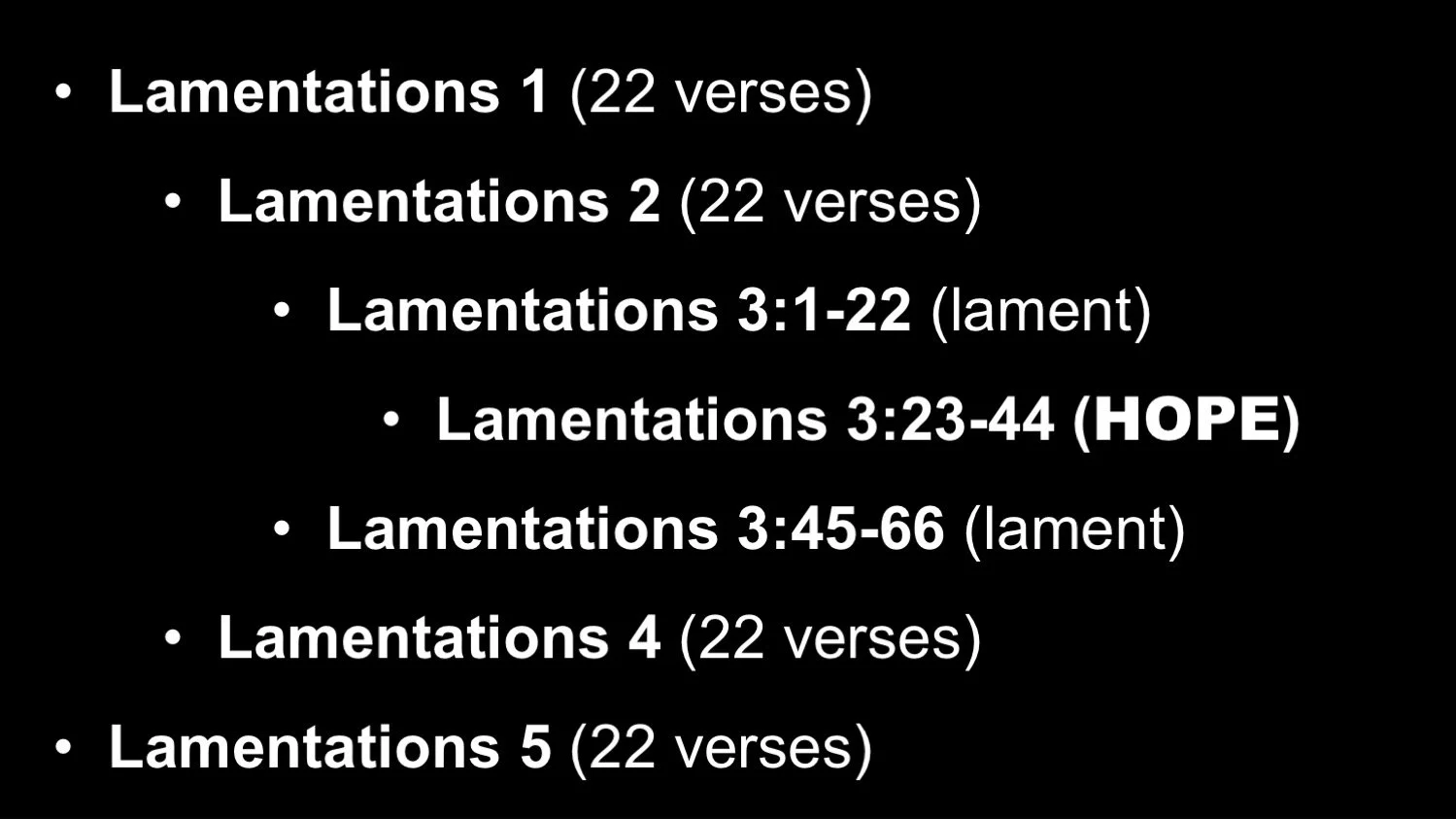
Now, we’ve seen this structure in the Bible before – it’s called a chiasm.
Chiasms were an ancient way of structuring a story or a poem—where the first section corresponds to the last section, the second section to the second last section, all the way down. Visually, it creates something like an arrow—pointing to the hidden treasure (the most important part of the book) which is buried right in the middle.
The core of this book (full of sadness, heartache, and loss)—the central section of the central poem—is hope!
22-24 God’s loyal love couldn’t have run out,
his merciful love couldn’t have dried up.
They’re created new every morning.
How great your faithfulness!
I’m sticking with God (I say it over and over).
He’s all I’ve got left.
25-27 God proves to be good to the one who passionately waits,
to the person who diligently seeks.
It’s a good thing to quietly hope,
quietly hope for help from God.
It’s a good thing when you’re young
to stick it out through the hard times.
28-30 When life is heavy and hard to take,
go off by yourself. Enter the silence.
Bow in prayer. Don’t ask questions:
Wait for hope to appear.
Don’t run from trouble. Take it full-face.
The “worst” is never the worst.
We’re using The Message translation for this series. The Message is a paraphrase of the Bible in modern English. But you might recognize some of these verses from the old King James Version:
22 It is of the Lord's mercies that we are not consumed,
because his compassions fail not.
23 They are new every morning:
great is thy faithfulness.
“Great is thy faithfulness… thy compassions, they fail not… Morning by morning new mercies I see.” Does this remind you of anything? YES – the hymn “Great is Thy Faithfulness” was inspired by Lamentations 3.
The author of this book has compiled these five heavy poems about darkness, sadness, and loss. But at the center of it all (the heart of this book) is an affirmation of hope!
And we’re only halfway through! There’s a lot more darkness to come! And there are no other explicit affirmations of hope in the entire book—just at the center.
I don’t think we’d do it that way if we wrote it today. Because we’re modern people, right? And modern people think very linearly. We want to see a progression—a growth curve. The chart is always tracking up and to the right, yes?
If we wrote the book of Lamentations, the affirmation of hope would come at the end. It would be the resolution. After wading through four chapters of grief and sadness, we would end on a high note. As if to say: “Don’t worry! Don’t lament—it’s all gonna work out in the end! Everything will be okay!”
But that’s not the message of this book. And that’s not how grief works.
Grief is not linear. Sadness doesn’t follow a formula. There is no predetermined pathway for Lament that always ends in the positive. Grief comes in waves. After a loss (in the immediately aftermath) a lot of people just feel numb. Your body goes on autopilot. You’re just moving forward, pushing through, unable to process.
Oftentimes, it’s not until later—after the services are over, and the guests have all gone home, and the cards and the calls stop coming. THAT’S when the grief hits. And this avalanche of sadness bombards us out of nowhere.
Sometimes, we work through the grief, we process, we move on, we find hope, we start to heal. But then, the slightest thing sends us right back into it. That’s normal!
About ten years ago, I had a really bad falling out with a friend. He betrayed my trust, said some things that really hurt me. And I did not respond the best, let’s be clear. But that falling out ruined the relationship. And processing that took a long time.
I used to wake up at night, thinking about it. I’d replay the conversation in my head, over and over. I talked to a therapist about it. I spoke to some mentors. I even did this practice where I prayed for this person every day for a month. That’s an interesting experiment, let me tell ya!
After about a year, I finally felt like I was over it. I finally felt like I had moved on. But then, I was at a conference and ran into this former friend of mine—and it all came rushing back. I was right back in it!
That doesn’t negate the work I did. That doesn’t mean my processing was in vain. It’s just a reminder that grief is not literal. Whether you’re grieving the loss of a friend, a loved one, a divorce, estrangement, a dream that didn’t live up to your expectations—grief is not linear and that’s okay. That’s how it works. That’s why the hope of Lamentations is buried at the center and not at the end.
In this third poem, we meet a new character. Gone are the Narrator and Lady Zion from chapters 1 and 2. And in their place, we have: “the man.”
1-3 I am the man who has seen trouble,
trouble coming from the lash of God’s anger.
He took me by the hand and walked me
into pitch-black darkness.
Yes, he’s given me the back of his hand
over and over and over again.
The “man” in this passage is actually the Hebrew word: geber. But geber doesn’t just mean man.
A geber is a protector. A warrior. A soldier charged with protecting women and children. We might even translate it: bodyguard. A geber is a protector of the vulnerable.
These poems in Lamentations were written after the destruction of Jerusalem by the Babylonians. We’ve talked about this in previous weeks. In 586 BC the Babylonian army laid waste to Jerusalem—destroying the temple, killing about half the people, and forcing the survivors into exile.
In this third poem, we meet a geber—a protector. A warrior charged with protecting the vulnerable members of their community. A protector who failed.
Can you imagine that pain? Exile is horrible enough—to be forcibly relocated from your home, after losing everything and everyone you love. To become a refugee, basically. Compound that loss with being one of the people who was charged with protecting your city—protecting your family and your home. That’s the speaker in Lamentations 3.
Not surprisingly, in the midst of his grief, the protector is all over the place. He’s in shock! His head’s spinning. He doesn’t know what to make of his loss—or of his God!
In the opening section of this poem, it’s pretty clear that the protector ascribes this loss to God. God is in control and ultimately this is God’s fault:
1 I’m the man who has seen trouble,
trouble coming from the lash of God’s anger…
4-6 He turned me into a skeleton
of skin and bones, then broke the bones.
He hemmed me in, ganged up on me,
poured on the trouble and hard times.
He locked me up in deep darkness,
like a corpse nailed inside a coffin.
7-9 He shuts me in so I’ll never get out,
handcuffs my wrists, shackles my feet.
Even when I cry out and plead for help,
he locks up my prayers and throws away the key.
This is in keeping with an ancient view of God as the one controlling everything. The man behind the curtain, moving all the levers that control things here on earth. That understanding of God gives way to this affirmation of hope…
22 God’s loyal love couldn’t have run out,
his merciful love couldn’t have dried up…
26-27 It’s a good thing to quietly hope,
quietly hope for help from God.
It’s a good thing when you’re young
to stick it out through the hard times…
31-33 Why? Because the Master won’t ever
walk out and fail to return.
If he works severely, he also works tenderly.
His stockpiles of loyal love are immense.
He takes no pleasure in making life hard,
in throwing roadblocks in the way:
34-36 Stomping down hard
on luckless prisoners,
Refusing justice to victims
in the court of High God,
Tampering with evidence—
the Master does not approve of such things.
So, blaming God, gives way to trusting God, which then gives way to accusing God again…
37-39 Who do you think “spoke and it happened”?
It’s the Master who gives such orders.
Doesn’t the High God speak everything,
good things and hard things alike, into being?...
42 “We’ve been contrary and willful,
and you haven’t forgiven.
43-45 “You lost your temper with us, holding nothing back.
You chased us and cut us down without mercy.
You wrapped yourself in thick blankets of clouds
so no prayers could get through.
One minute, God’s good—the next minute, God’s bad. “God’s with us, but then God’s against us. God’s punishing us because God hates injustice, but this punishment is unjust. God listens and is quick to forgive. But God’s not forgiving us! God, are you even listening?”
The poet is in shock! He doesn’t know if he’s coming or going. He doesn’t know what to make of God. “Should I be mad at God right now? Should I be praising him? Do I need to repent?” All of this is a normal part of grief. It all belongs.
We live in a culture of extremes. Everything is either black or white—clear cut. We like that because it’s predictable and consistent. But life is not consistent! Faith is not predictable. There’s a lot of uncertainty. There’s a lot of ups and downs. That’s normal and the Bible makes space for that.
It’s normal to question God in the midst of suffering. To doubt God’s goodness. To wonder if God even cares at all. That’s a normal part of faith. It’s healthy. And the Bible encourages it!
There’s no narrator in this poem who shows up to chastise the protector. There’s no effort by the poet to tidy up or edit out the uncertainty. The poet just lets it sit there for all of us can see.
Don’t let anyone edit out your grief. Don’t let anyone tell you that anger at God is off limits. If you need to be angry at God, be angry at God. Voice your complaint to God. Be honest with God about your uncertainty. God can handle it.
When I’m counseling couples, I don’t worry so much about couples who get angry with each other. Couples that argue and occasionally yell. That’s normal and relatively healthy. I worry about the couples who aren’t speaking at all. The couples that never argue and just bottle up all those emotions to fester.
Honestly expressing anger is a step toward healing. Being honest with God about your grief and how you’re feeling is a step toward rebuilding intimacy. It’s normal for your head to spin in these situations. It’s normal to be confused and question God. The Bible, in Lamentations, makes room for that.
I mentioned that Lamentations 3 is the only poem in this book with an explicit affirmation of hope. The bulk of that comes in the center of the poem. But there are echoes of hope elsewhere. It’s not clean. The hope in this poem is fragile and uncertain. It wavers. That’s normal! But the darkness wavers too.
There’s a tug-of-war playing out in the poet’s heart between darkness and light, hope and despair. And we have a front row seat.
55-57 “I called out your name, O God,
called from the bottom of the pit.
You listened when I called out, ‘Don’t shut your ears!
Get me out of here! Save me!’
You came close when I called out.
You said, ‘It’s going to be all right.’
The protector is still in darkness when he makes this affirmation of hope. His circumstances haven’t changed. Things haven’t gotten better. He hasn’t been rescued. His tensions with God are not resolved. But that hope is there—where we’d least expect it.
Hope doesn’t always make sense. It’s inexplicable. Hope is a grace. It comes out of nowhere to reassure us in the midst of the loss, often when we least expect it.
Reflecting on this poem, Old Testament scholar Kathleen O’Connor has this to say:
“Biblical hope does not emerge from proper reasoning or new information. It is not optimism or wishful thinking. It is not a simple act of the will, a decision under human control, or a willful determination. Hope emerges without clear cause like grace, without explanation, in the midst of despair and at the point of least hope. It comes from elsewhere, unbidden, illusive, uncontrollable, and surprising.”
Hope is inexplicable. It doesn’t always make sense—kinda like grief. Hope shows up when we’re not expecting it. It surprises us! Hope arrives unsure, fleeting, wavering, but there nonetheless.
Hold onto hope this Advent season. The Light is coming. Our Protector who knows our pain and empathizes with us is coming to be born in our hearts, all over again. That little baby in the manger—born into a world of chaos, confusion, and death, is the hope at the center.
Lean on that hope in the midst of the darkness. Amen.
The Death of Abraham (8.17.25)
A sermon on Genesis 25:1-11.
As part of my job, I do a lot of funerals. When I first started here at the church, that was one of the things I was most anxious about, actually. Because I had zero experience with funerals. I was afraid that I wouldn’t be any good at it—I wouldn’t have what it takes to console families or eulogize someone well.
Fast forward seven years and (believe it or not) funerals are now one of the highlights of my job. It’s a sacred duty that I take really seriously to come alongside a family in grief. Walk with them. Pray for them. Plan a memorial service with them that’s gonna truly honor their loved one.
It’s especially rewarding to do a funeral for someone who was well-loved. To see the outpouring of stories and memories. Open mics that go on and on, with one person sharing after another. A true celebration of life.
It’s a lot harder doing a funeral for someone who didn’t love well and wasn’t well loved in return. I remember a graveside service early on (it wasn’t a family from our church). But it was clear that there was some baggage around the departed. When I met with the family to plan the service, you could cut the tension in the room with a knife.
All the standard questions I ask when planning a funeral: “What fond memories do you have of the person? What was he like? What did you like to do together?” Total silence. No one was willing to eulogize this guy. No one wanted to speak at the graveside. As his son told me: “Let’s just keep it short and sweet and get him in the ground.”
I suppose that’s how some of us might feel when we come to death of Abraham.
Abraham’s life was a mixed bag. We’ve been reading his story together now for a few months. It’s a story with some incredible highs and some really low lows.
Abraham was the first person in recorded history to worship the God that we worship. A God who is worshipped today by some 4.5 billion people around the world—Christians, Jews, and Muslims. That’s more than half the world’s population that now follows the God of Abraham. That’s significant!
Abraham was a man of incredible faith. He trusted God and followed God, even when God didn’t make sense. He showed incredible hospitality to strangers and foreigners—likely because Abraham was (for much of his life) a foreigner.
At his best, he lived at peace with his neighbors and was a blessing to those around him. But at his worst, it got really bad.
We’ve read the stories. Abraham exploited his wife, Sarah, on multiple occasions. He exploited his enslaved concubine, Hagar. He exiled his oldest son, Ishmael when he was just a child. And he tried to sacrifice his second son, Isaac.
There’s also a lot about Abraham that we don’t know. When we first meet him in Genesis, he’s already 75 years old. That means we know nothing about his youth, his upbringing—those first 75 years of life.
His son Isaac was born when Abraham was 100. And then Abraham dies at the ripe old age of 175. Which means that (if these numbers are correct) he lived a whole other lifetime (another 75 years!) that we know almost nothing about.
During that time, he buried his wife Sarah. He got remarried to a woman named Keturah (who, again, we know nothing about). Abraham and Keturah had six more sons (and who knows how many daughters). And then Abraham died. His two eldest sons, Ishmael and Isaac, buried him in a tomb next to Sarah.
Abraham’s story reminds me of a lot of “great men” (so-called) from history. Men like Thomas Jefferson, George Washington, Alexander Hamilton. Men who we remember as heroes and build massive monuments to (temples, really). Individuals who did some incredible things—but also some terrible things. Owning slaves. Mistreating women.
It’s complicated to think about our relationship to these figures. What stories do we tell about them? What stories do we ignore? The ugly aspects of ourselves that they reflect back to us.
There was a movement not too long ago of tearing down Confederate monuments in the South—statues of Robert E. Lee and Jefferson Davis that were put up in the 1960s to counter the Civil Rights movement. A number of those monuments are now being re-erected by the current administration.
As a proud Northerner, I’m all for tearing down Confederate statues. Burn ‘em all, in my opinion. But I’m a lot more conflicted over statues of George Washington. I don’t know how to feel about those—just like I’m not sure how to feel about Abraham.
I got curious this week and started wondering how the Bible memorializes Abraham. Father Abraham is one of the heroes of the Bible—his name comes up again in Scripture. So, I looked into it. I pulled up every occurrence of Abraham’s name in the Bible and read through all of them. And what I found was actually kind of surprising.
If you look in the Old Testament after the book of Genesis—so… from Exodus to Malachi—there are only 43 references to Abraham. His name only occurs 43 times in the entire Old Testament, after Genesis.
To give you a visual for this, I’m gonna take this pew Bible and go to the end of Genesis… that’s right here. Then, I’m gonna flip to the end of the Old Testament in Malachi… which is right about here.
In all these pages Abraham’s name only shows up 43 times. That’s not a lot! By contrast, Moses’ name occurs 716 times—in this same section! Only 43 references to Abraham. I think the biblical authors might be just as conflicted about his legacy as us!
When Abraham’s name does show up in the Old Testament, it’s often in a genealogy—those long lists of names: “So and so begat so and so.” Individual characters will be called “son of Abraham.” Descendant of Abraham. Sometimes God is referred to as: “The God of Abraham.”
But by far, the most common way Abraham is mentioned in the Old Testament is in reference to God’s promise to Abraham. “Remember God’s promise to Abraham.” God was faithful to Abraham—that same God will be faithful to us.
When the Israelites are enslaved in Egypt: “Remember God’s promise to Abraham.”
When they’re tempted to turn and follow other gods—to try their luck with competing deities: “Remember God’s promise to Abraham.”
When all seems lost and God’s people start to lose hope: “Remember God’s promise to Abraham.”
These references to Abraham in the Bible aren’t actually about Abraham—they’re about God and God’s faithfulness. “God was faithful to a scoundrel like Abraham—God’s gonna be faithful to you.”
There’s no effort in Scripture to whitewash Abraham’s story—erase the problematic parts. Indeed, most of the stories we have about Abraham ARE the problematic parts. The Bible doesn’t present this guy as a hero—someone to admired or emulated. The Bible presents Abraham as a complicated, sinful man whose primary function is to serve as an example of God’s faithfulness.
God kept God’s promises to Abraham, despite all his shortcomings. God’s gonna keep God’s promises to us.
God’s faithfulness to us does not depend on our faithfulness to God. It’s not something we earn by minding our Ps and Qs, following all the rules. God’s faithfulness just is. God’s love is a gift offered freely. There’s nothing you can do to earn it and there’s nothing you can do to lose it.
The New Testament talks about Abraham a fair bit too. The latter part of our Bibles (the section about Jesus) has a lot of references to Abraham—72 to be exact, which is more than the Old Testament. And in the New Testament, we find a lot of the same stuff—Abraham shows up in genealogies, there’s callbacks to his story, reminders of God’s faithfulness. But the new idea that gets introduced in the New Testament is that (through Jesus) we are all adopted into the family of Abraham.
This story about God working through one family to bless all the families of the earth—that story gets blown wide open in Jesus to include everyone. All of us who follow Jesus are adopted into Abraham’s family. We are invited to partner with God in restoring the world.
The promise God to made to Abraham 4,000 years ago—“I’m gonna bless you, and give you descendants, and all the families of the earth will be blessed by you.” That promise is now available to us. We are invited to be that blessing.
I see examples of Christians being that blessing all the time. I see it in small churches that run soup kitchens, shelters, pantries. Just last week, I read a news story about a church in Oregon that’s demolishing its sanctuary in order to build a new building, with a smaller worship space, and over 100 units of low-income housing. Every six months or so, there’s a story of some mega church that pays off medical debt for people in their community. So many examples (big and small) of God’s people being that blessing!
I see it here in our church—with the warming center, the food pantry, our Helping Hands fund, families in our church who are finding love and support, people who are struggling with their faith discovering our church to be a safe place to wrestle with hard questions. That’s what being a blessing looks like. That’s like Abraham at his best.
But I also see plenty of examples of God’s people failing to be that blessing. Churches doing harm to people. Christian nationalists trying to strip rights away from women and minorities. Zionists in the Israeli government advocating for the genocide of Palestinians. Radical Islamists declaring jihad—all in the name of the God of Abraham.
The complicated life of Abraham—with all those highs and lows—is a microcosm of God’s people, writ large. At our best, we do amazing things. God shows up in a big way! At our worst—holy crap! Right?
It’s kinda like the Founding Fathers—their complexity is really our complexity. Fights over how we tell the story of Thomas Jefferson have very little to do with Thomas Jefferson. He’s been dead for 200 years! Thomas Jefferson doesn’t care what we write about him in the history books. It’s a reflection of us!
How we tell these stories is really more about we tell our story. Who are we and what is our history? That’s the question we wrestle with when it comes to the Founding Fathers, and it’s a question the church wrestles with when it comes to Abraham. And that wrestling is never gonna stop. It can’t stop! We have to wrestle with this.
Because Abraham’s legacy is our legacy too. And if there’s any grace to be found—any good news for us, the children of Abraham—it’s that God’s faithfulness doesn’t depend on ours. God remains faithful, even when we screw it up. God is faithful to us because God loves us—and thanks to Jesus, that love includes everyone.
A couple years ago, I did a funeral for a guy who lived a really hard life. Made a lot of mistakes. Hurt some people. And in talking to his family, it became really clear that they were worried about him. They came from a conservative religious background. And they knew this guy wasn’t a Christian.
So, one of the questions they asked me was: “Is he in hell? I’m so worried that he’s in hell—and I can’t bear to think of it.”
Now, let me acknowledge—that question is WAY above my paygrade. And I told them as much. I said: “Look, I didn’t know him. I don’t know his heart. I have no idea where his understanding of God was at, if there was a bedside conversion. I don’t know the factors in his life that led him to choose the path he chose.”
“But let me ask you this—do you love him?” They said: “Yes, we love him so much.” I was like: “How much? How would you measure your love for him?” They we like: “It can’t be measured—we just love him so much.”
Then I said: “God loves him infinitely more than you do. However much you cared for him, loved him, worry about him—I guarantee you God loves him even more. Let’s try to trust God with that and lean into that grace.”
I truly believe that God remembers us for our best day, not our worst day. God remembers us for our best day, not our worst day.
When God looks at our lives, I don’t think God sees a record of wrongs—every little mistake we made, every act of selfishness, every time we exploited someone or messed things up. I think God looks at our lives and sees us at our best—our best days, our triumphs, the mountain top experiences, those times we encountered God and were truly changed.
God looks at our lives and sees Jesus, interceding for us, advocating on our behalf, covering our sins with his life.
God remembers us for our best day, not our worst day. That’s the grace I have for us. And that’s the grace I have for Abraham.
Abram son of Terah, was born in the land of Ur. He immigrated with his family to Haran, before leaving his father’s house at the age of 75, on a leap of faith. He was a wanderer, a refugee, a victim of famine, who settled in the Promised Land of Canaan and changed his name to Abraham.
He was predeceased by his parents, his brother Haran, and his wife Sarah. He is survived by his nephew Lot, his concubines Hagar and Keturah, his sons Ishmael, Isaac, Zimran, Jokshan, Medan, Midian, Ishbak, Shuah, and their families. As well as countless grandchildren and great-grandchildren.
Abraham was a man of faith, who leaves behind a complicated legacy. He was blessed to be a blessing, but often failed at that call. He died at the age of 175—old and full of years—and was laid to rest with his ancestors. His life stands forever as an example of God’s radical love and faithfulness. Amen.